
International Baccalaureate Diploma Programme (IB)

The International Baccalaureate Diploma Programme (IB) is a two-year international education programme that students complete during the final two years of their studies at Open Gate. It culminates in a globally recognised diploma, which may replace university entrance examinations at some institutions. Open Gate students take the IB Diploma alongside the Czech national school-leaving examination.

The IB is a comprehensive programme that develops not only in-depth academic knowledge, but also the practical skills students need for further study and for life in a rapidly changing world. It places strong emphasis on critical thinking, working with sources, analysing data, constructing arguments, writing essays and presenting ideas clearly. Volunteering, sport and other extracurricular activities are also an integral part of the programme.
At Open Gate, the IB Diploma is an optional part of the curriculum alongside the compulsory Czech national school-leaving examination. More than two thirds of our graduating students choose to complete the IB each year, including many who go on to study at universities in the Czech Republic. We believe that the programme’s greatest value lies not in the final examinations themselves, but in the learning process and personal development students experience over the course of the two years.
Open Gate was authorised to offer the IB Diploma Programme in 2009, becoming one of the first schools in the Czech Republic to do so. Our students consistently achieve above-average results compared with the global IB average. The school’s long-term average score is 36.2 points, and nine Open Gate students have achieved the maximum possible score of 45 points.
How Does the IB Diploma Programme Work?
The programme consists of two interconnected components: six academic subjects and the IB core. Students choose six subjects from the individual subject groups. At least three and no more than four are studied at Higher Level (HL), while the remaining subjects are taken at Standard Level (SL).
Higher Level and Standard Level differ not only in difficulty, but above all in the scope and depth of study. This combination allows students to maintain a broad academic foundation while exploring in greater detail the subjects most closely related to their interests and future studies.
The Six IB Subject Groups
1 | Language and Literature
first language, literature and work with different types of texts, developing skills in interpretation, analysis and precise expression
- Czech Literature
- English Language and Literature
both courses are compulsory
2 | Second Language
developing proficiency in a foreign language
- German
- French
- Spanish
3 | Individuals and Societies (Humanities)
- History
- Psychology
- Economics
- Global Politics
- Business Management
4 | Experimental Sciences (Natural Sciences)
- Biology
- Chemistry
- Physics
- Computer Science
- Environmental Systems
5 | Mathematics
- Mathematics: Analysis and Approaches
- Mathematics: Applications and Interpretation
6 | Arts
- Visual Arts
under certain conditions, students may replace an arts subject with an additional subject from another subject group
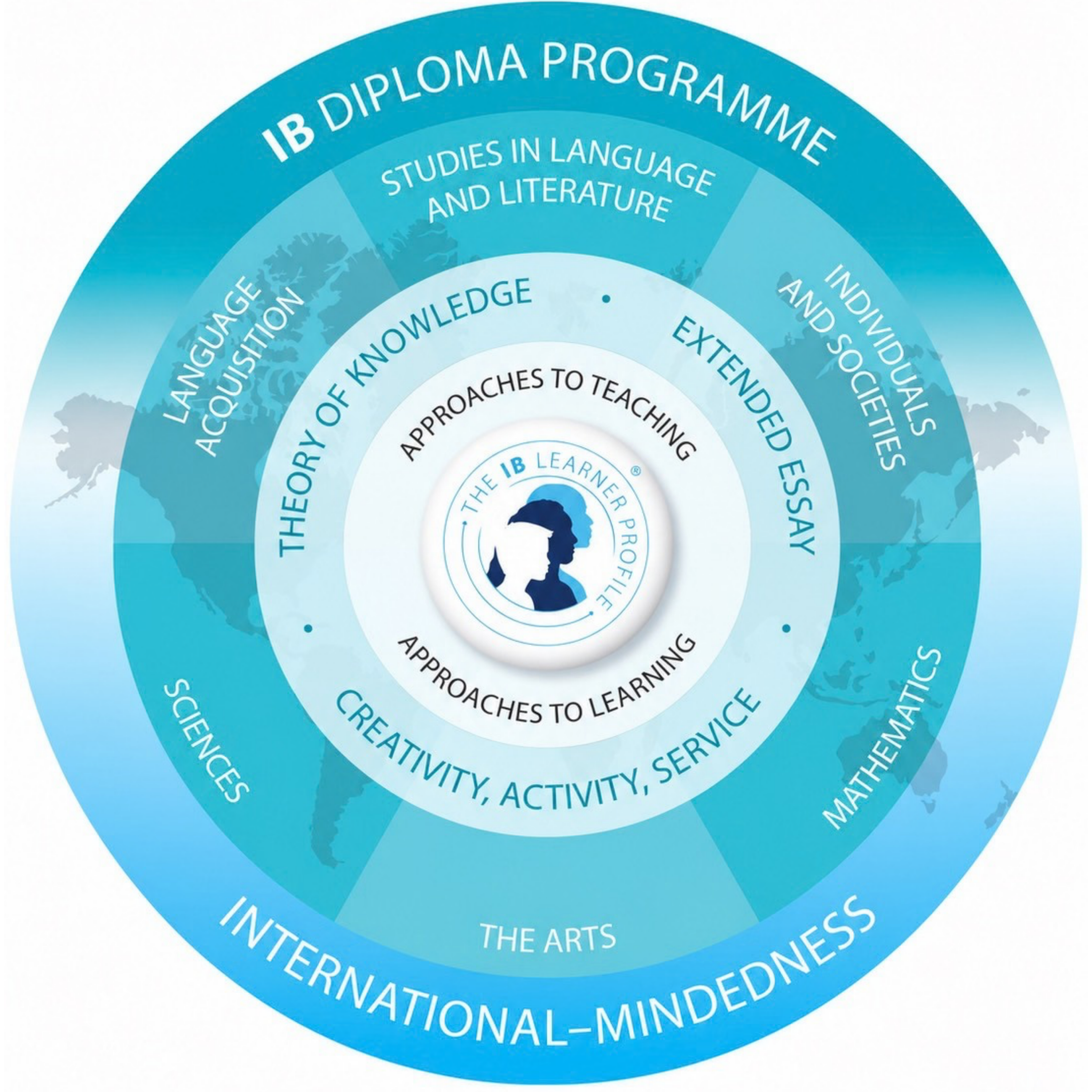
The IB Core
Alongside the six academic subjects, every student must complete three compulsory components known as the DP core. These components help students develop additional knowledge and skills, learn to work independently, reflect critically and apply what they have learned successfully in a range of different situations.
Theory of Knowledge | TOK
Theory of Knowledge (TOK) encourages students to reflect on the nature of knowledge itself. It connects different subject areas and develops critical thinking. Students learn to question their own assumptions, consider different perspectives and explore how knowledge is created.
Extended Essay | EE
Extended Essay (EE) is an independent research project. Students choose a topic that genuinely interests them, formulate a research question and, with the guidance of a supervisor, work through the entire research process, from conducting background research and evaluating sources to developing and defending their own conclusions. While working on the EE, students acquire skills and research methods they will later use at university. They learn how to formulate an appropriate research question, find and evaluate information, develop arguments, work independently and plan a long-term project.
Creativity, Activity, Service | CAS
The third component of the IB core is Creativity, Activity, Service (CAS). Throughout the programme, students take part in activities across three areas:
- Creativity includes creative activities and experiences that develop creative thinking.
- Activity focuses on movement and physical activities that promote a healthy lifestyle.
- Service is voluntary service that benefits others while providing valuable experience for the student.
CAS is not graded and does not contribute points to the final IB score. However, successful completion of CAS is a requirement for receiving the IB Diploma. Its purpose is to balance the academic demands of the programme with experiences beyond the classroom and to support students’ personal and social development.
IB Assessment
Assessment combines final written examinations with assignments and coursework completed throughout the two-year programme. Depending on the subject, these may include laboratory work, oral examinations, written assignments, projects or other forms of assessment.
Each of the six subjects is graded on a scale from 1 to 7 points. Students can earn up to 3 additional points for Theory of Knowledge and the Extended Essay, bringing the maximum possible IB Diploma score to 45 points.
To receive the diploma, students must achieve at least 24 points and meet the programme’s other requirements, including successful completion of all three components of the IB core.
